Paradox · Infinity
Achilles and the tortoise
The argument
Achilles runs at ten metres a second. The tortoise manages five, so it is given a head start of a hundred metres.
Before Achilles can overtake, he has to reach the place where the tortoise started. By the time he gets there, the tortoise has moved on fifty metres. So he has to reach that place, and by then the tortoise is twenty-five metres further on. Then twelve and a half. Then six and a quarter.
There is always one more gap to close. Zeno of Elea, in the fifth century BC, concluded that Achilles never catches the tortoise, and that motion as we see it cannot be what it seems.
What the scene shows
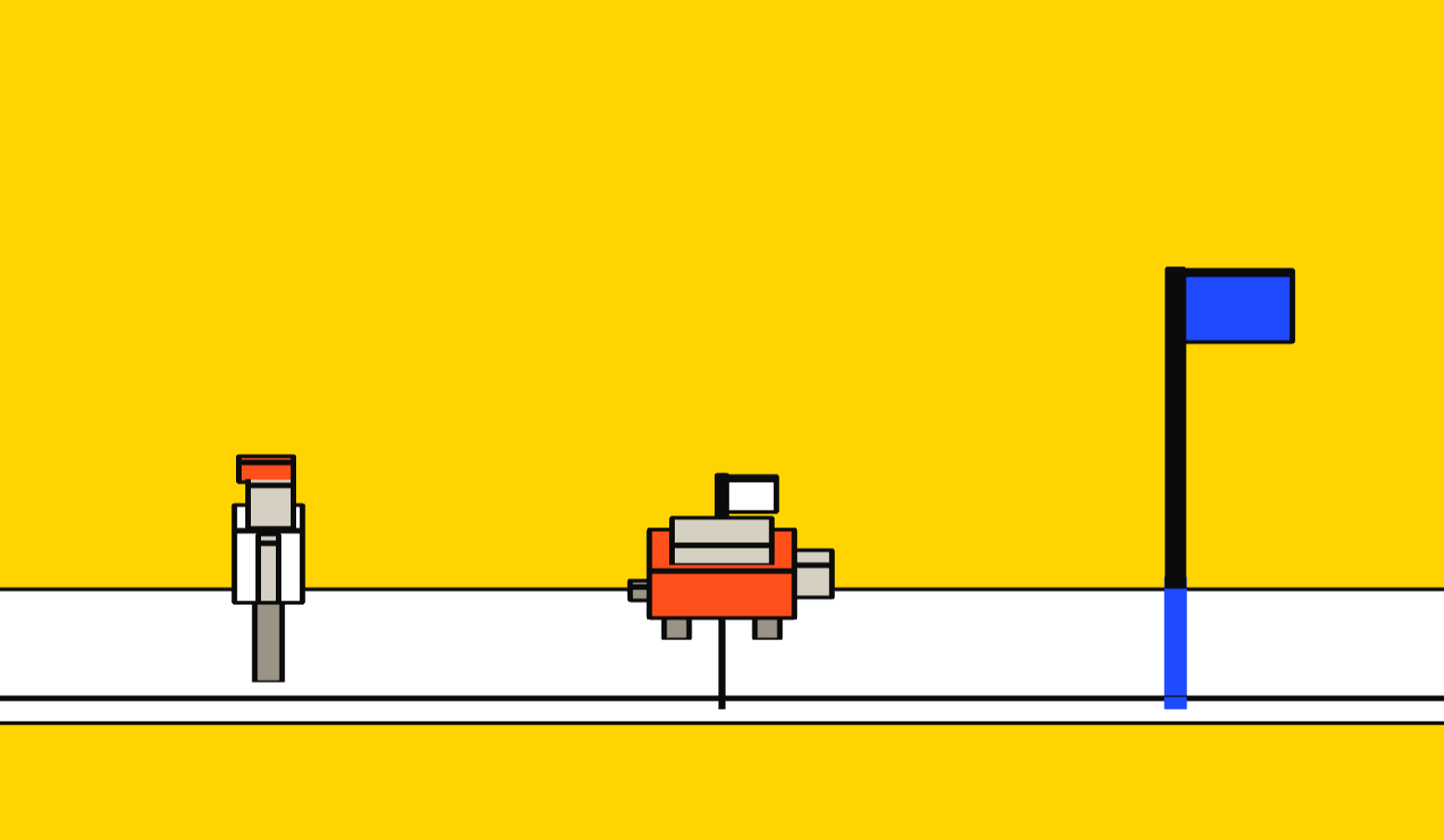
Each step of the scroll is one of Zeno’s stages. A flag goes up wherever the tortoise has been, and Achilles always has one more flag to reach. The camera zooms in by a factor of two every time, so the gap always looks the same size on screen. That is exactly the trick of the argument: it keeps you staring at a gap that never seems to shrink.
The strip underneath shows the whole race at a fixed scale, and there the two runners are plainly closing in on the 200 metre mark. Keep scrolling past the last step and the camera pulls back: Achilles goes through the gate and carries on.
Now look at the panel beside it. The distances being added are 100, 50, 25, 12.5 and so on. Each is half the one before, and the total creeps towards 200 metres without ever passing it. The time behaves the same way and creeps towards 20 seconds.
Where the argument breaks
Zeno counts the steps and finds there are infinitely many. He then assumes that infinitely many steps must take forever. That is the hidden premise, and it is false.
The steps get shorter as fast as they get more numerous. Add them up:
100 + 50 + 25 + 12.5 + … = 200
An infinite list of numbers can have a finite sum. Achilles needs infinitely many stages, but all of them together fit inside twenty seconds. At second twenty he is level with the tortoise, two hundred metres down the track, and at second twenty-one he is five metres ahead.
Why it took two thousand years
The Greeks had no way to give a number to the sum of infinitely many terms. That only became rigorous in the nineteenth century, when Cauchy and Weierstrass defined a limit: the total is the value the partial sums get arbitrarily close to. With that definition, the paradox turns into a short calculation.
Whether the calculation settles the philosophical question, how anyone can actually complete infinitely many tasks, is still argued about. But as a race, it is over in twenty seconds.