Illusion · Perception
The Penrose triangle
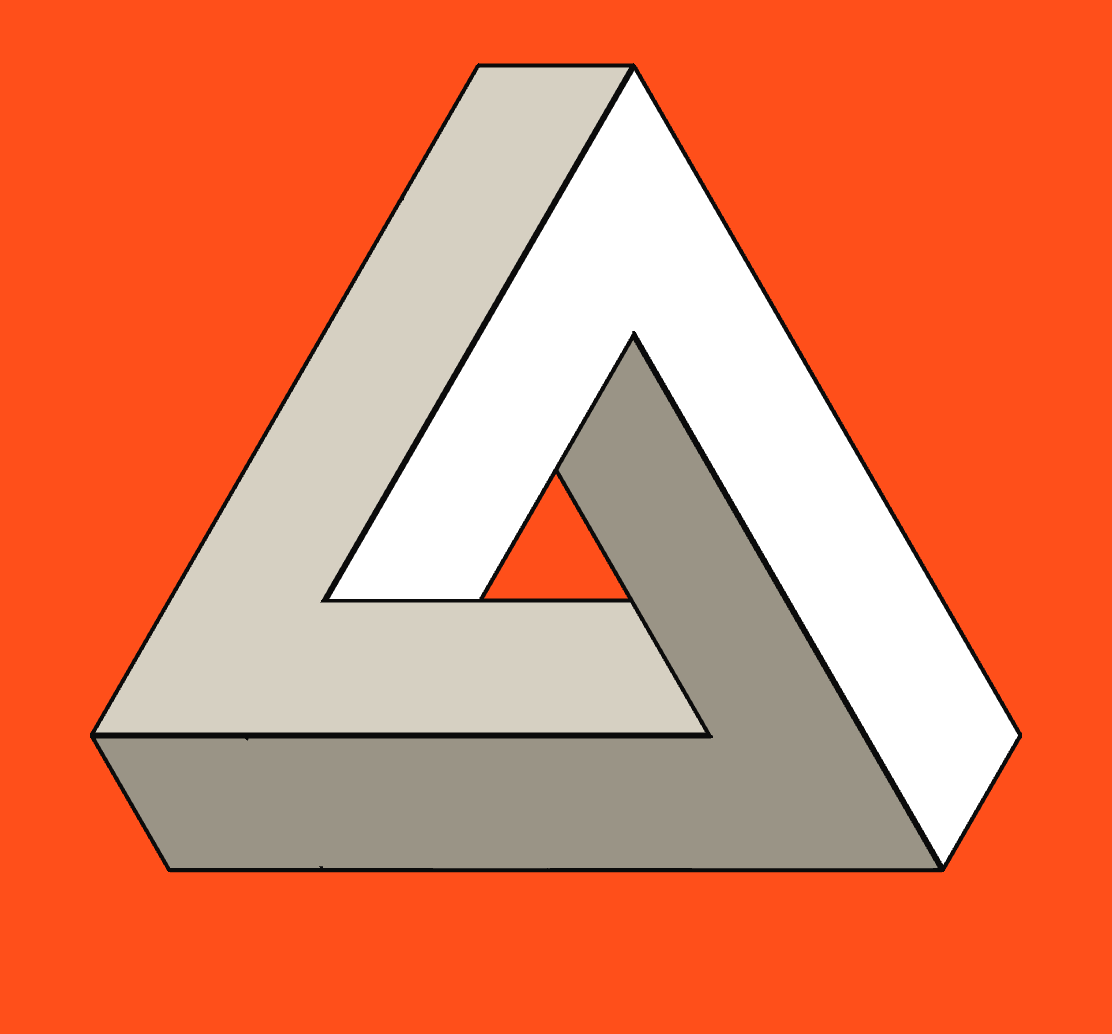
What you are looking at
Three square beams. Each one meets the next at a right angle, the way two walls meet a floor in the corner of a room. Follow them round and they close into a triangle.
That cannot happen. Three right angles add up to 270°, and the angles of a flat triangle add up to 180°. Walk along three beams that each turn 90° into a new dimension and you end up far from where you started.
Turn it
Drag the model. The moment the camera leaves its starting position the triangle opens: the last beam never reaches the first. They are a full beam-length apart, one near you and one far away.
The object was never impossible. Only the drawing was.
Why it fools you
From one precise direction the far end of the last beam lines up exactly with the near end of the first. There is no perspective in this view, so distance does not shrink anything, and nothing tells your eye that one end is further away.
Your visual system then does what it always does: it assumes that things which touch in the image touch in the world. Each corner, taken alone, is a perfectly ordinary corner. Your brain accepts all three and never checks whether they can exist together.
Where it comes from
The Swedish artist Oscar Reutersvärd drew the figure in 1934. Lionel and Roger Penrose rediscovered it and published it in 1958, calling it “impossibility in its purest form”. M. C. Escher built the endless watercourse of Waterfall (1961) from two of them.