Illusion · Perception
The Ames room
What you are looking at
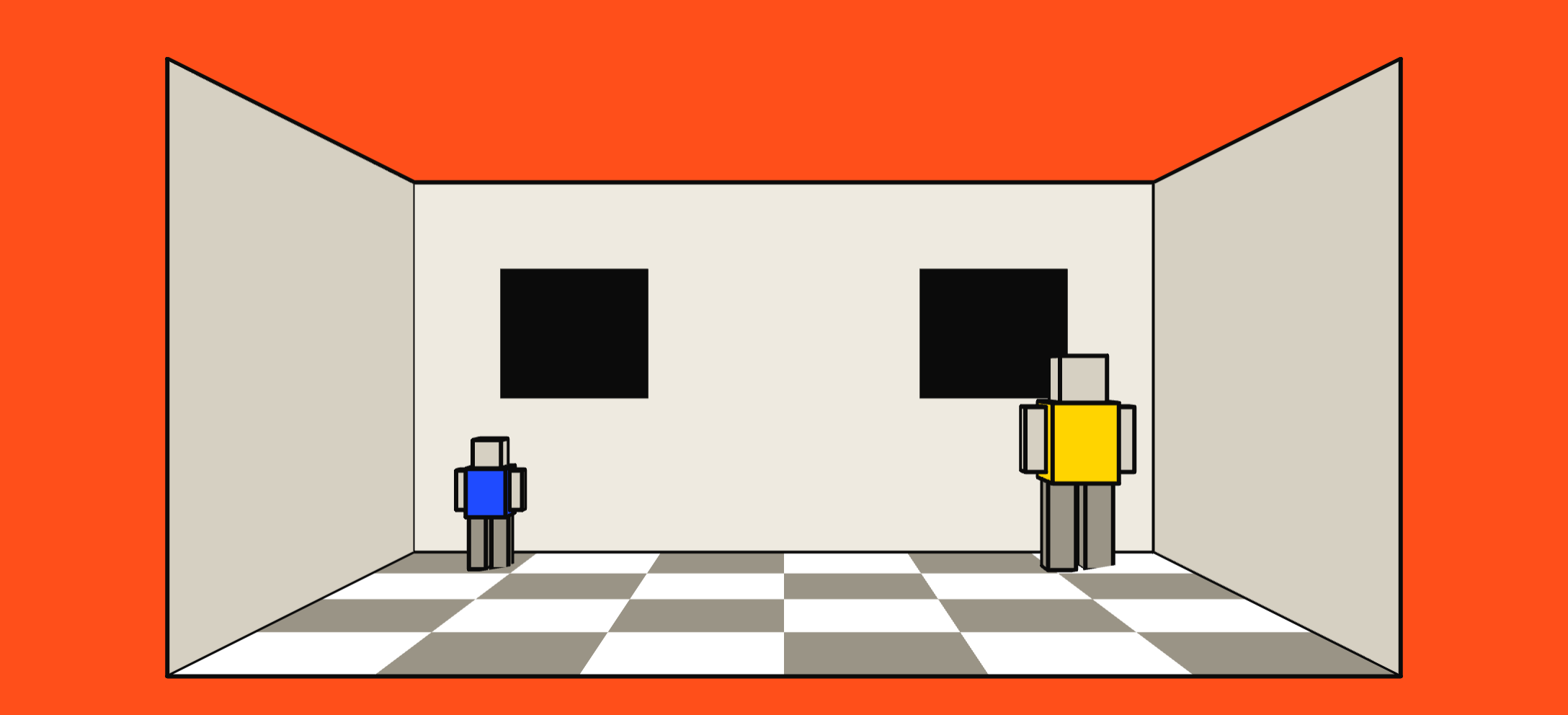
A plain room seen through a peephole: a chequered floor, a back wall with two windows, two people standing in the far corners. One of them is about twice as tall as the other.
Press Swap places. They walk across the room, and as they go one shrinks and the other grows. Nobody changes size in real life. Something else must be wrong.
Step out of the peephole
Drag the view, or press Look from above. The room is not a box. The back wall runs away diagonally: the left corner is twice as far from the peephole as the right one. The floor slopes, the ceiling slopes the other way, and the two “identical” windows are different sizes.
The two people are exactly the same height. One is simply standing twice as far away.
Why it fools you
Every surface of the room has been stretched along the lines of sight from the peephole. From that single point, the far-left corner sits precisely behind where the corner of an ordinary room would be. The image that reaches your eye is the image of a normal rectangular room, down to the last floor tile.
A peephole gives you one eye and no way to move your head, so the two best clues to depth are gone. Your brain has to guess, and it makes the guess that has been right about every room you have ever stood in: the walls are square. If the walls are square, both people are at the same distance. And if they are at the same distance, the one who takes up half the space in the image must be half the size.
The striking part is what your brain chooses to give up. It would rather believe that a person shrinks than that a room is crooked.
Where it comes from
The American ophthalmologist Adelbert Ames Jr. built the first one in 1946, working from an idea of Hermann von Helmholtz. The same trick, called forced perspective, makes the hobbits small beside Gandalf in The Lord of the Rings: the actors sit far apart, and the set is built so that you cannot tell.