Paradox · Probability
The Monty Hall problem
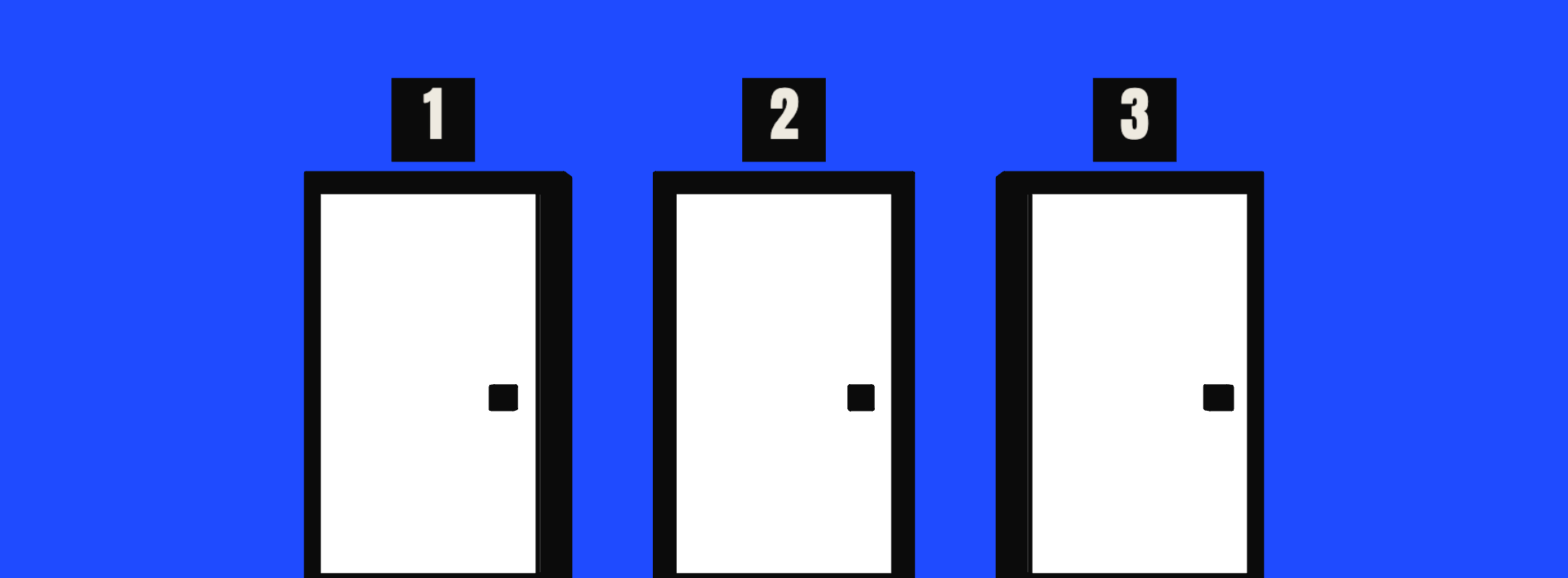
Pick a door. One hides a car, two hide goats.
- Your games
- Stay 0 won out of 0
- Switch 0 won out of 0
Now play it ten thousand times
Every simulated game counts for both strategies at once: staying wins when the first pick was right, switching wins when it was wrong.
- Switch – 0 won out of 0
- Stay – 0 won out of 0
Run the simulation to watch the two lines settle.
The game
There are three closed doors. Behind one is a car; behind the other two, goats. You pick a door. The host, who knows where the car is, opens one of the other two doors and shows you a goat. Then he asks: do you want to stay with your door, or switch to the other closed one?
Two doors are left, so it feels like a coin flip. It is not. Switching wins two times out of three.
Why switching wins
Your first pick is right one time in three. Nothing the host does afterwards can change that: he will always be able to open a goat door, whatever you chose.
So one time in three the car is behind your door, and switching loses. The other two times in three the car is behind one of the two doors you did not pick, and the host has just shown you which of those two it is not. Switching takes you straight to it.
Staying is a bet that your first guess was right. Switching is a bet that it was wrong. It was wrong two times out of three.
The version that makes it obvious
Imagine a hundred doors. You pick one. The host opens ninety-eight of the others, all goats, and leaves a single door closed. Would you stay with your one-in-a-hundred guess, or take the door he so carefully avoided?
Three doors work exactly the same way. The numbers are just small enough to hide it.
Why it feels wrong
The host’s choice is not random, and that is the part intuition drops. If he opened a door by chance and happened to find a goat, the two remaining doors really would be equally likely. But he knows where the car is and never reveals it, so his choice carries information about the doors you did not pick, and none about yours.
A famous argument
In 1990 Marilyn vos Savant gave the correct answer in her Parade magazine column. She received around ten thousand letters telling her she was wrong, nearly a thousand of them from readers with a PhD. The mathematician Paul Erdős is said to have accepted the result only after seeing a computer simulation.
The simulation above is that argument. Run it and watch the lines settle.